Precarious Joys: Toronto Biennale of Art '24
11:06pm I feel really fascinated, excited and grateful for having the opportunity to have attended my first Biennale of Art in the context of developing my first art thesis. It seems surreal.
1st note:
My spiritual journey/trance seeing Cecilia Vicuña's work for the first time ever:
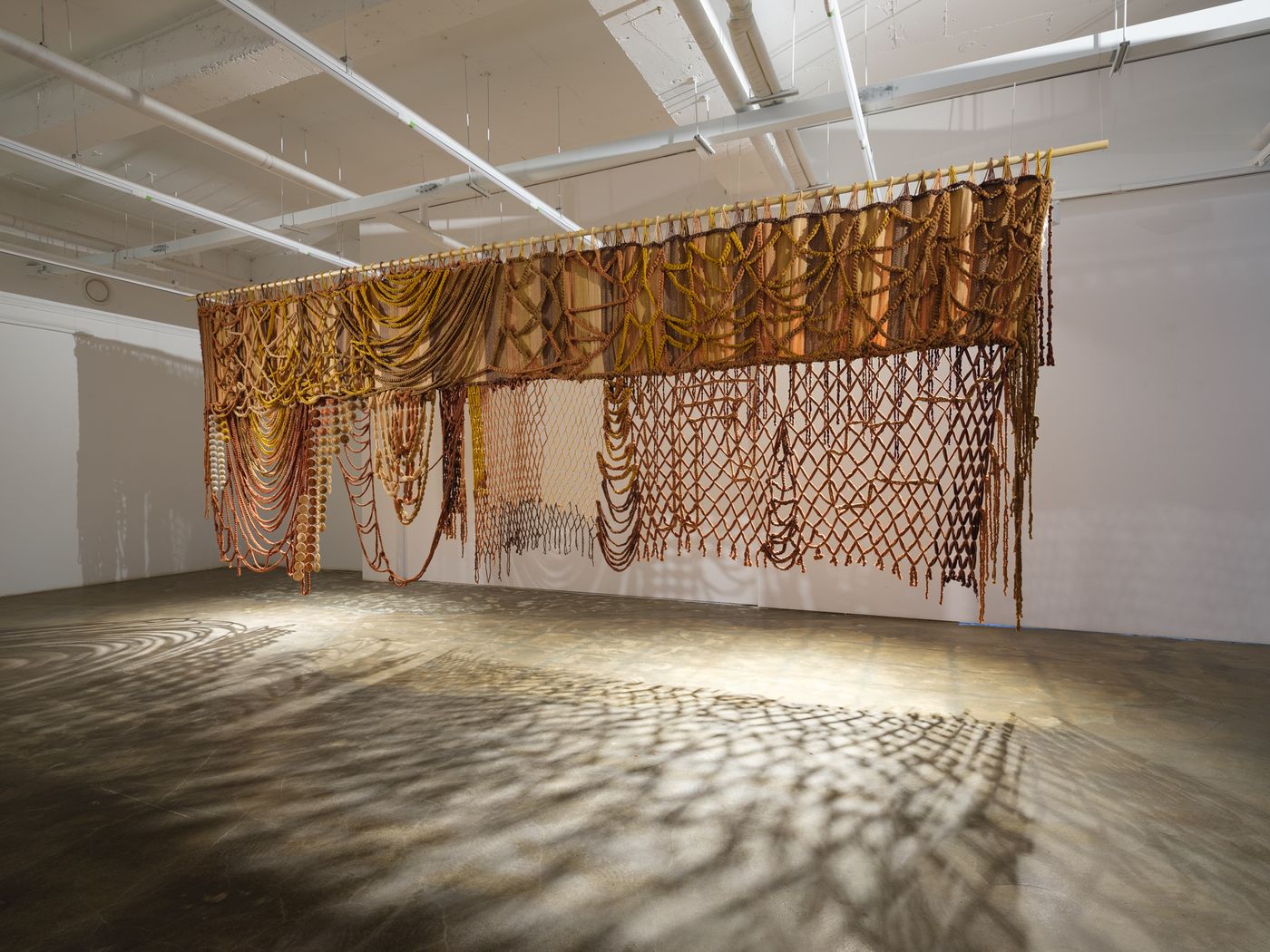
My landmark was when I saw Cecilia Vicuña's work; without knowing who the author was, I already knew it was hers, and I wasn't even aware she was gonna be in this exhibition. It's my first time seeing Vicuña's work in person, after having studied and research and read so much of her artworks and other of her ideas and stories. It feels like the right time to have met (her) work at this moment of my life. I completely immersed myself in its installation and I didn't want the experience to stop. I went into it without haven't read anything, not even to confirm if Cecilia was indeed the author of this piece, and I started; 1) analyzing the montage and how the hell did they put up all those panels on site, the logistics of the installation as per usual, 2) then, I moved into carefully observing the material used, describing the texture and possible names of the fabrics used, and the materials used ON them. I felt like I was having a conversation with her in a way. After reading so much of her work and intentions and themes and thoughts, I feel I could see something in the work that intervened beyond the mere visuals...

Cecilia Vicuña, Quipu Girok, 2021.
I felt connected to South America again; the aesthetics, what (little) narrative I could interpret or read in it felt very familiar, the colours and especially the sublime of it; the size really embraced me into the experience of being embraced by Cecilia's message; by our region in a way,, reaching out to me and sending me a message through the mark-making and the knowledge-making these textiles are tied to. Then, I finally read the art statement (lol).


Precarious Objects by Cecilia Vicuña
- Iconic
(first encountered in my first Hopkins read <3)
- Wrapped concept of "Precarious Joy" perfectly

Cecilia Vicuña
CeciliaIn my long life, this is the first time I have been asked about the role of invisible justice in the world. The way my art began is connected to that question. I was a teenager. I was on a beach in Chile that I had been to many times. It was summer, but because it's the southern Pacific, even in summer, there is a cold wind. Suddenly I felt the wind moving differently than it usually does; it enveloped me around my waist, as if the wind was taking the trouble to go around me like a snake. That startled me. I turned around, and in that gesture of turning around, I understood that the wind, the light, the sea, everything was aware. And I knew that meant that everything I knew, up to that moment, wasn't exactly valid and true. One of those things was self-perception-who I was or what I was. I completely dissolved, melted from that understanding, in all the beauty of what that meant. That was the moment when my precarious art began.
The invisibility of that gesture was radical. I knew that. But I also knew that the beach knew it, the sea knew it, the light knew it. In that memory-the memory that counts for future generations and for the transfiguration of thought systems in the world-it counted (p. 23)
CeciliaWhen I created the precarious art and ordered those little pieces of debris on the beach, I wanted to speak in terms that the sea and the light would see. That was my directive. If you speak to this earth, to the soil, to the sun, in a language that the sun can integrate and incorporate in its own terms, that, to me, is the work's ethics.
We as humans are completely misaligned with the ethics of all creatures, of all species, of all elements. If we can find a way to align with that, then a tremendous explosion of joy occurs, but not a joy that is necessarily recognized by the Western definition of joy, like "ha ha," not at all. It is a joy of comprehension, a joy that dissolves the ego, that dissolves the person to a new dimension. This is also related to what Ahmed said. Your desire to be seen is very similar. I wanted the sea to see that I saw it! (p. 25)
CeciliaMy partner and I have been writing a book for five years on the erasure of the mother. Every morning, we wake up to work on the book. The erasure of the mother is a key to the oppression of humanity. I's the key to the kidnapping of joy because joy is precarious, you know. And the precarious is joy. The relationship between the two is unknown to most people. (p. 31)
The West has created a version of precarious as something negative, which is the opposite of how I imagined the concept of precarious art in the 1960s. It is quite telling that my creation of the concept arte precario has rarely been acknowledged by scholars and academics who study precariousness. It's not just because I am a South American woman; it is difficult to comprehend that precariousness and our vulnerability is the source of joy. Because we are dying, we are committed to being joyful. That's how the animals exist.
A bird wakes up and starts singing!
I mean, the bird can die any moment, and the bird knows it. That's the thing. It is a beauty to be here with you both. (p. 31-2)
Cecilia
Well, too beautiful is just brutal joy.
Because, you see, that's what we are not allowed to embrace. What were not allowed is exactly the way we have to be. It's about being, not about saying. And our art is the way we are. If not, what is it? This idea that you have to be smart in art is bullshit. Art is alive when it is as close as possible to how you really feel, in our madness, our not knowing, our ignorance, everything that we are. It's not something that can be spoken, but it's something that, as you said in the beginning, is felt. It's felt by the ant, by the flies, by the kid in the next room. It's felt by everything. (p. 32)
"Precarious Joys" Interview by Dominique Fontaine and Miguel A. López. Toronto Biennale of Art 2024, 2024.
Back on topic...
Notes from my Thesis Journal:
Artists that inspired me deeply -----------
to revisit
★ Winsom Winsom
Who I just learnt that she's an ICON in Tkaronto's art scene and culture, as per Pamila Matharu's tribute to her...

Winsom Winsom's Ancestral Voice - on the concept of the "web"


Winsom Winsom, Roho Mlinz (Spirit Keeper), 2022


- there's nothing more beautiful (and joyful, for that matter) to see an artists paying tribute for a fellow artist, WOC, and to her community, to all the people that came before us, migrating and navigating the marginalization and racist violence of this so-called Canada. She's really inspiring and really making me feel that "precarious joy" Vicuña describes.
- Brown and Black women uplifting each other

- I realized the significance for a lot of them (us) to work with textile and fabric, the meaning of its development, and their visceral aim to revive pre-Columbian, Indigenous knowledge-making and art techniques that are either lost or erased in society (Western world especially).
- There's this urgency to (re)connect to their roots, especially since many of them have been (dis)placed in the Western world and that's where most of their work is sited. It becomes a site-specific fervent purpose and desire to bring these cultural ties and knowledge-making elements and skills to every corner at their reach
- reconnecting with ancestral knowledge through textile, weaving and its medicinal healing properties and significance


- I (DESPERATELY) need to see her work ASAP (at Auto BLDG)
- Her work, intentions, and way of thinking already makes me feel so connected to her as per this catalogue
- weaving as non-representational form of writing -> narrative-making!
- allows women to create deep communication among themselves and others, as well as reflecting collective memory


- (completely obsessed) large-scale textile installation
- skin as fabric (!!!!!!!) -> my (material) research topic for my advanced drawing class, regarding the concept of Mestizaje and complexities of this identity
Miguel
It is very much present. Many artists are raising issues that are very locally and temporally specific.
For example, some of them address how weaving tools and threads are infused with a spiritual agency that makes textiles home for communal resistance. The Maya Kagchikel artist Angélica Serech highlights the process of listening to an ancestral memory engrained in warping and weaving, reclaiming the connection between the territory, the threads, and her skin; it's an exploration of Guatemalan territory and collective-migration memories.
Similarly, Cristina Flores Pescorán created Acariciar el corazón del hueso (Caressing the heart of the bone) (2023-24) for TBA. Her contribution is a loom made of wood beams carved to resemble parts of her body; the installation works as a healing altar that addresses the power of sacred plants and as a testimony of her recovery from skin cancer. Their works remind me of what Aymara writer and poet Elvira Espejo Ayca asserts, that textile making is a mode of spiritual listening and sensory learning that takes place through the movement of the fingers, the perception of textures, and the smell of the wool. For her, a weaving instrument is not just a "tool" but a living being. (p. 93)
"Precarious Joys" Interview by Dominique Fontaine and Miguel A. López. Toronto Biennale of Art 2024, 2024.

- Passing (2022) is a completely clever and beautiful, outdoor installation. Very reminiscent of Latin American urban AND urbanized rural areas and being in the streets, around the neighbourhood, feeling violence through the air with signs of shoes like this, but also trying to make it home... she takes those aesthetics and doesn't modify them a lot but provides them to us, as precarious joys to feel connected to our region, transporting a familiar infrastructure or atmosphere to us from the distance... (<3). It really moves me, makes me yearn in a way to be there, but there's also the tension with that symbolic (shoe-on-cable) reminder of why we are so far away (violence, danger, displacement).
- On her Filiación abono (Dung kinship) video work, she was extremely hilarious and joyful to talk about the extremely violent reality of US colonialism and imperialism, Western-led land dispossession, and instilled violence in Mexico, and across the region, that a lot of the Toronto audience might not know. I was really laughing and smiling at how clever she conveyed a rough and violent experience of living in Mexico under capitalistic, neoliberal and extremely reinforced militarism and surveillance in many areas, especially near de US.
- Besides her work, I really connected with her interview on the topics "Home" and "coded" in the TBA 2024 catalogue. She eloquently and precisely express the conflicts Latinx communities and diaspora experience in movement, displacement and violence.
- She talks about language; bastard and ambiguous forms of language, provokes disturbance, uncertainty. And she embraces it.
Naomi Rincón Gallardo
I relate to the idea of refusing the demand for transparency that is connected to the imperative to be legible or reduced or measured in a way that one's work can be enclosed, appropriated, or conquered. But, at the same time, the word "coded" gives me shivers because I cannot think about the idea of producing new codes or coding without acknowledging that we are immersed in a moment where everything is already coded.
There's a compulsion to turn things, even life, into algorithms, and there are codes that we cannot read as humans because they're made by machines and for machines. It's like a posthuman impulse to create a whole universe that is readable only to the machine.
I think the question is about how to continue creating work that refuses to be scrutinized by the algorithm, that rejects, as Rita Laura Segato puts it, this masculine mandate, colonization, and patriarchy-this mandate to turn life into something that is measurable, to turn life into property, and to expand forms of control, appropriation, and subjugation! The way I try to refuse this desire for assimilation is to use a language that goes beyond the visual and that involves the texture of the performative and the sensorial in the wider sense, in a Baroque way. I find myself compelled by languages that are bastards and that are responses to the violent imposition of colonial power: languages that are impure, that embrace an illegitimate character and acknowledge that it comes from conflictive spaces full of impurities, ambiguities, and contradictions, and languages that also gather lots of clashing realities that escape definition, reduction, or transparency. You can see that in our multilayered cultures and histories as a colonized society. The way we celebrate is like the past constantly coming back, as if there were burps from a past that have been undigested. (p. 222-3)
Naomi
The Bolivian feminist theorist Silvia Rivera Cusicanqui uses the concept of the chi xi, which is "the multicoloured"-it's about something that is not gray, nor black and white, but an amalgam of different colours that escapes any kind of synthesis? Actually, it's connected to Glissant's idea and this Baroque being in the world, which embraces how disturbance proliferates and suggests that there is no possibility for certainty. It's a matter of redundancy, proliferation, the co-presence of different temporalities, and multiple clashes. (p. 223)
Naom!
For me, the question of home resonates when what happens when the place you call home becomes a dangerous place and when being alive also becomes dangerous. I lived for some years in the Global North, between Berlin and Vienna, but then decided to return to Mexico, living between Oaxaca and Mexico City. However, over the last two decades, Mexico has been turning into an expanding necropolis. The so-called war against narco [drugs) started around 2006, but there are other informal wars that have unleashed violence, dispossession, forced displacement, femicide, and the multiplication of military and paramilitary forces. These things are coming ever closer and closer.
These necropolitics are spreading horizontally. How do you talk about home when home has become a burned place?
I think I share with many people from my generation the feeling that we've lost home or we've lost a country. We are more and more exposed to different forms of aggression, and things that we used to do in our youth are no longer available to us or the coming generations. For me, the question of home has to do with how to live in a dignified way in a place that is damaged and how to live with what is left. How do you manage to live surrounded by this multiplication of ghosts, and how do you deal with the losses? What kinds of losses can you handle, what can still be repaired, how can we care for each other and the environment, and how can we sustain and share our lives together-I mean more widely, not only in Mexico, but the question of home also has to do with how we live in a land at this moment of so-called eco-social capitalism and devastation. How do we find home in places that are wasted and poisoned? Sorry for bringing this darkness, but it is an existential question that has stuck with me.
How can art give an account of these dark times? (p. 227)
Naomi
I find myself thinking about how we can give an account of the horror of our times while at the same time not reproducing the grammar of violence. Instead, how can we join the challenge of creating desire-driven narratives or rethinking disobedience, desire, and pleasure instead of victimization? I saw that another word in the key directives youre using is joy, right? This is important because you don't want just survival. You want to enjoy, you want to have pleasure, you want to play, and you want to dance and sing. How can we do that?
I think art has this faculty to deal with and metabolize the darknesses of our times, but at the same time, there is the power to create same rolleye pitality everything. We find ways to enjoy ourselves, and we find ways to sing together and dance. This sort of performative relationality is something that I try to propel or use in my work, as if I'm preparing a party or a celebration for a journey, like a surrealist journey to occupy a territory to remember a person who has been killed and to make her current legacy proliferate and expand into the future.
I once was told by a person who had a relative who was killed that if we cannot afford justice, we have to fight to create different forms of memory. In this idea of not reproducing a grammar of violence and not offering a direct, transparent version of things, that's where I use strategies that are connected to surrealism. I write poetry and lyrics, but I also welcome bodily noises, whispers-like roars-all these kinds of bodily noises that, for me, are a way to engage with visceral knowledge.
The project that I'm planning for the Toronto Biennial is really going into the guts, into the visceral, into the scatological (…) (p. 230)
"Precarious Joys" Interview by Dominique Fontaine and Miguel A. López. Toronto Biennale of Art 2024, 2024.


This comment has been removed by the author.
ReplyDeleteHi Juanita! I've included here the link to DAWA collective a group that the artist Winsom has been a part of for decades! They regrouped and showed within the past couple of years with an exhibition that started in Toronto before travelling across the country...I think they're exhibiting in Ottawa right now but the show should be at a gallery in Hamilton within the next couple of months if you want to see more of her work in person! I hope this helps!! https://en.wikipedia.org/wiki/Diasporic_African_Women%27s_Art_Collective
ReplyDelete